
Frequently Asked Questions · Question 4 of 10
Didn't They Take Books Out of the Bible at the Council of Nicaea?
Short answer: no. Here is what really happened, and where the story came from.
- THE CLAIM
- At the Council of Nicaea, Emperor Constantine and the bishops picked which books went into the Bible and threw the rest out.
- THE VERDICT
- False. The council never voted on the books of the Bible. Not one of its records says a word about it.
- WHEN
- Late spring and summer of AD 325.
- WHERE
- Nicaea, a city in what is now Turkey. Today the town is called Iznik.
- WHO CAME
- About 250 to 300 bishops, mostly from the eastern half of the Roman Empire. Later tradition says 318.
- WHAT IT DECIDED
- That Jesus is fully God, the same as the Father. It also set how to find the date of Easter and made 20 rules for running churches.
Get Nate's Highlighting Guide Free
Free. No spam. Unsubscribe anytime.Something went wrong. Please try again, or email [email protected].
The Story You Have Probably Heard
Maybe a friend told you. Maybe you saw it in a movie. The story goes like this: for 300 years Christians had dozens of gospels and nobody agreed on anything. Then in AD 325 Emperor Constantine called a big meeting at Nicaea. The bishops voted on which books to keep, tossed out the ones they did not like, and even voted that Jesus was God.
It is a great story. It is just not what happened.
What Really Happened at Nicaea
The fight at Nicaea was about one man's teaching. Arius was a popular priest in Alexandria, Egypt. He taught that the Son of God was created by the Father. His slogan was, there was a time when He was not. Arius said Jesus was the greatest of all created beings, but not God the way the Father is God.
His bishop, Alexander of Alexandria, said that was wrong. The argument spread across the empire. Constantine had just ended years of civil war, and he did not want the church splitting in two. So he called the bishops together and paid for their travel.
The bishops wrote a creed, a short statement of what Christians believe. It says Jesus is God from God, Light from Light, true God from true God, begotten, not made, of one being with the Father. The Greek word for of one being is homoousios.
Then they voted. It was not close. Almost every bishop signed. Only two refused, and they were sent away with Arius.
- ON THE TABLE
- Who Jesus is, the date of Easter, a split in the Egyptian church, and 20 church rules called canons.
- NOT ON THE TABLE
- Which books belong in the Bible. The creed, the 20 canons and the letters written by people who were there never mention it.
Did They Vote That Jesus Is God?
They voted on how to say it, not whether to believe it. Christians had worshiped Jesus as God for almost 300 years before Nicaea. John calls Him God, John 1:1. Thomas falls at His feet and says, My Lord and my God, John 20:28.
Even an enemy noticed. Remember Pliny, the Roman governor from Exhibit A? Around AD 112 he wrote to the emperor that Christians met before dawn and sang a hymn to Christ, as to a god. That was more than 200 years before Nicaea.
So When Was the Bible Put Together?
Nobody invented the Bible at a meeting. The church recognized books that were already being read as Scripture, and it happened slowly.
THE OLD TESTAMENT. Jesus already had a Bible. He called it the Law of Moses, the Prophets and the Psalms, Luke 24:44.
THE FOUR GOSPELS. By about AD 180, Irenaeus, a bishop in Gaul, wrote that there are four Gospels, no more and no fewer: Matthew, Mark, Luke and John. That is 145 years before Nicaea.
PAUL'S LETTERS. Peter already calls Paul's letters Scripture, 2 Peter 3:15 to 16.
A FEW BOOKS WERE DEBATED. Some churches were slow to accept Hebrews, James, 2 Peter, 2 and 3 John, Jude and Revelation. Some read extra books, like the Shepherd of Hermas. A few even treated it as Scripture for a while, but in the end the churches left it off the list.
THE FIRST EXACT LIST. In AD 367, 42 years after Nicaea, Bishop Athanasius wrote a letter listing the 27 books of our New Testament, the same 27 we have today. Church meetings at Hippo in AD 393 and Carthage in AD 397 agreed. For the whole story, see Why Do Some Bibles Have More Books?, Why Do Some Bibles Have More Books?.
What About the Lost Gospels?
The Gospel of Thomas, the Gospel of Judas and the Gospel of Mary are real ancient books. But they were written in the 100s and 200s, long after the apostles, and they were never in any church's list of Scripture. You cannot take a book out of the Bible that was never in it. They get their own pages next, What About the Gnostic Gospels?, What About the Gnostic Gospels?.
Where the Myth Came From
A STRANGE LEGEND. About AD 887, more than 550 years after the council, an unknown Greek writer told a tale. He said the bishops set all the books by the altar and prayed, and the true books were found lying on the altar while the false ones lay underneath. Nothing like it is in the records of the council.
VOLTAIRE. In the 1760s the French writer Voltaire, who loved to poke fun at the church, retold that legend in his Philosophical Dictionary. Skeptics kept repeating it.
THE DA VINCI CODE. In 2003 Dan Brown published the novel The Da Vinci Code, and in 2006 it became a movie starring Tom Hanks. A character in the story says Constantine made a new Bible, left out the gospels that showed Jesus as human, and that Jesus became God by a close vote at Nicaea. The book sold more than 80 million copies, and suddenly everybody had heard it.
It is a novel. Novels are allowed to make things up. The trouble is that millions of people thought the history part was true.
- THE CLAIM
- Constantine chose the books of the Bible.
- THE FACT
- He did order 50 new copies of the Scriptures for the churches of his new city, Constantinople, around AD 331. The historian Eusebius tells the story. That was copying books, not choosing them.
- THE CLAIM
- Jesus became God by a close vote.
- THE FACT
- Almost every bishop signed. Christians had worshiped Jesus for 300 years.
- THE CLAIM
- The lost gospels were thrown out at Nicaea.
- THE FACT
- They were never in. No record from Nicaea mentions them.
ONE ODD LINE. About 75 years after the council, the scholar Jerome wrote that the Council of Nicaea is said to have counted the book of Judith as Scripture. No record from Nicaea says that, and Jerome only said it is reported, without saying where he got it. Even if it were true, it is the opposite of the myth: a book being kept, not books being thrown out.
The Day Santa Slapped a Heretic
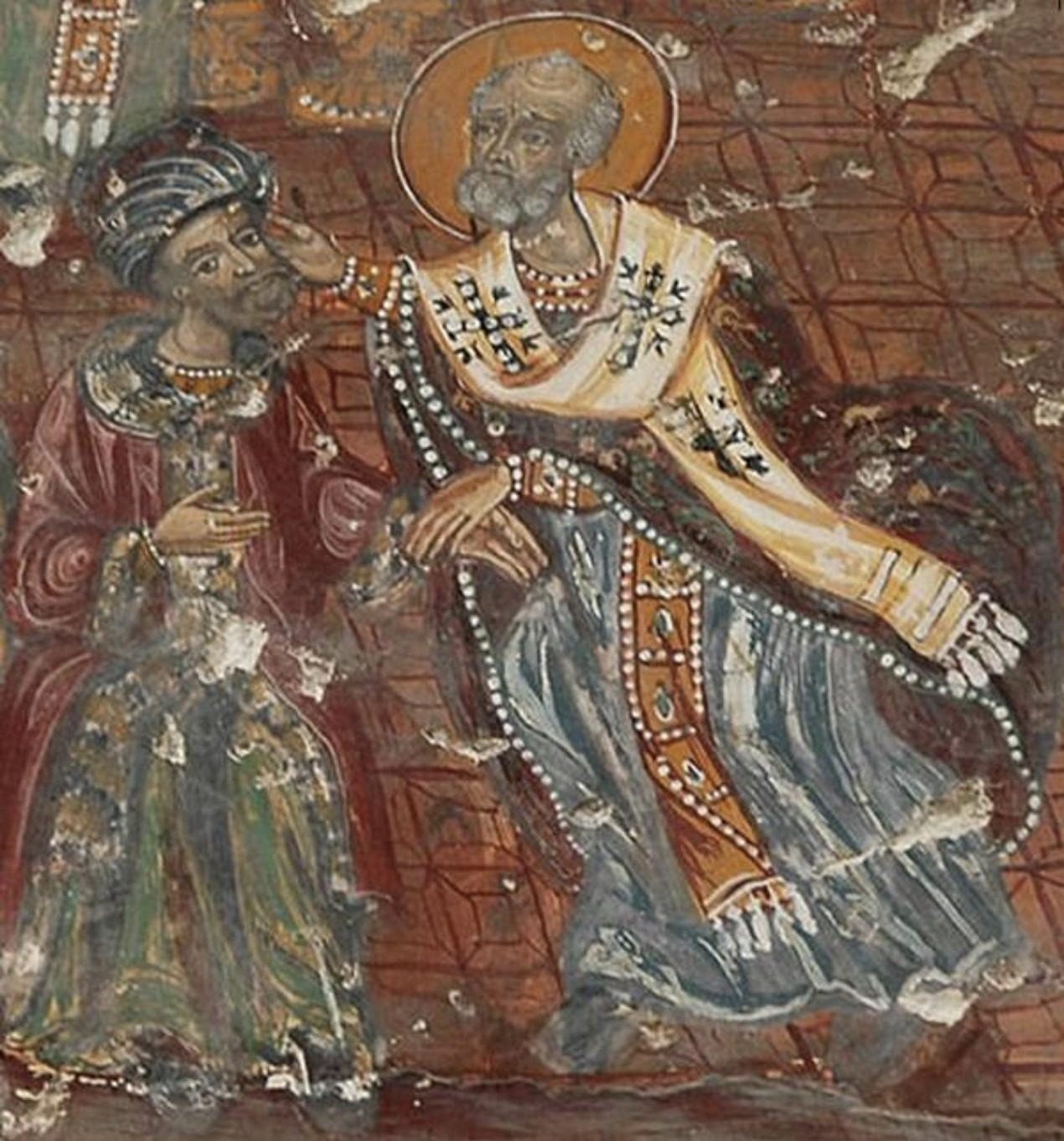
Now for the best story from Nicaea. One of the bishops there, says tradition, was Nicholas, the bishop of Myra, a town on the southern coast of what is now Turkey. Yes, that Nicholas. Saint Nicholas. The one who became Santa Claus.
The story goes that Arius stood up and explained his teaching, on and on, that the Son of God was created. Nicholas listened as long as he could. Then he walked across the room and slapped Arius right across the face. Some versions say it was a punch.
The other bishops were shocked. Hitting someone in front of the emperor was a crime. They took away Nicholas's bishop's robe and his book of the Gospels and locked him in jail.
That night, the story says, Jesus and Mary appeared to Nicholas in his cell. Jesus handed him back his book of the Gospels, and Mary put his bishop's robe back on his shoulders. In the morning the guards found him dressed as a bishop again, and he was set free. Old icons in Greek and Russian churches still show this scene.
- IS IT TRUE?
- Probably not, at least not the way it is told. The earliest records of the council do not mention a slap, and Nicholas's name is missing from some of the oldest lists of the bishops who were there. The story first shows up in writing about 1,000 years later, in the late 1300s. The oldest version does not even name Arius. It just says Nicholas hit a follower of Arius.
- CONFIDENCE
- LOW for the slap. HIGH that Nicholas of Myra was a real bishop in the 300s. MEDIUM that he was at Nicaea.
- THE LESSON
- Even Santa ended up on the naughty list that day. Jesus said, If someone slaps you on your right cheek, turn to him the other also, Matthew 5:39. He did not say, slap the heretic first.
The Verdict
The Council of Nicaea was a real meeting about a real question: who is Jesus? The bishops answered that He is true God from true God. They did not pick the books of the Bible, they did not throw any books out, and they did not turn Jesus into God by a close vote.
The books of the Bible were recognized by Christians over time because they were already being read as the word of God. The church did not create the Bible. The Bible created the church.
Next questionWhat About the Gnostic Gospels?See the Whole Bible in Color
Free. No spam. Unsubscribe anytime.Something went wrong. Please try again, or email [email protected].