
Frequently Asked Questions · Question 6 of 10
Why Do Some Bibles Have More Books?
Protestant, Catholic, Orthodox and Ethiopian Bibles, and how each list came to be.
- PROTESTANT
- 66 books: 39 in the Old Testament, 27 in the New.
- JEWISH
- 24 books in the Hebrew Bible, the Tanakh. They are the same as the Protestant 39, just counted differently.
- CATHOLIC
- 73 books: 46 in the Old Testament, 27 in the New.
- EASTERN ORTHODOX
- About 76 to 79 books, depending on the church. The Old Testament list was never fixed by one council.
- ETHIOPIAN ORTHODOX
- 81 books, the biggest Bible in the world, including 1 Enoch and Jubilees. Not 88, see below.
- THE GOOD NEWS
- All of these Bibles have the same 27 New Testament books. The broader Ethiopian list adds some church books. The fight is almost all about the Old Testament.
Get Nate's Highlighting Guide Free
Free. No spam. Unsubscribe anytime.Something went wrong. Please try again, or email [email protected].
First, a Word: Canon
The list of books a church accepts as Scripture is called the canon. The word comes from a Greek word for a measuring stick. A canon book is a book that measures up.
Here is the key thing to know. Nobody sat down one day and invented the Bible. God's people recognized books that were already being read and trusted as God's word. Then, sometimes hundreds of years later, councils wrote the list down to settle arguments.
The Jewish Bible Came Together in Stages
THE TORAH, ABOUT 400s BC. The five books of Moses, Genesis to Deuteronomy, were the first to be treated as Scripture. When Ezra read the Law to the whole nation after the exile, about 450 BC, everyone stood up to hear it, Nehemiah 8:1 to 8. The Samaritans, who slowly split off from the Jews over the next few centuries, still accept only these five books.
THE PROPHETS, BY ABOUT 200 BC. Joshua through Kings, and the prophets Isaiah, Jeremiah, Ezekiel and the Twelve, Hosea to Malachi, came next. A Jewish teacher named Ben Sira, writing about 180 BC, praises Isaiah, Jeremiah, Ezekiel and the Twelve Prophets as a group. His grandson, about 130 BC, speaks of the Law, the Prophets and the other books.
THE WRITINGS, BY ABOUT AD 100 TO 200. Psalms, Proverbs, Job, Daniel and the rest. Jesus speaks of the Law of Moses, the Prophets and the Psalms, Luke 24:44. Around AD 95 the Jewish historian Josephus says the Jews have 22 sacred books, and about AD 100 the book called 4 Ezra counts 24. The rabbis still argued over Song of Songs and Ecclesiastes for a while, but both stayed in.
- A MYTH TO SKIP
- You may hear that a Jewish Council of Jamnia closed the Hebrew Bible about AD 90. Most scholars now say there was no such council. There were rabbis at Jamnia, or Yavneh, but no official vote on the books.
- THE BOTTOM LINE
- By the time of Jesus the Jews already had a Bible, and by about AD 200 its list matched the 39 books of the Protestant Old Testament.
Then Came the Greek Bible
In the 200s and 100s BC, Jews in Alexandria, Egypt, translated their Bible into Greek, the language most people spoke. This Greek Bible is called the Septuagint. Over time, copies of it also carried other Jewish books written in the last few centuries before Jesus: Tobit, Judith, Wisdom of Solomon, Sirach, Baruch, 1 and 2 Maccabees, and extra chapters for Esther and Daniel.
The early church spoke Greek, so it used the Septuagint. The New Testament writers quote it often. They sometimes echo these books, and Jude quotes 1 Enoch, which is not one of them, but they never call the extra books Scripture, and the Jews did not count those books in their Hebrew Bible. That is the root of the whole disagreement.
The Early Church Disagreed Too
MELITO. About AD 170, Bishop Melito of Sardis traveled to the Holy Land to find out exactly which books were in the Old Testament. His list matches the Hebrew Bible, only missing Esther.
ATHANASIUS. In AD 367 Athanasius listed our 27 New Testament books. For the Old Testament he mostly followed the Hebrew list, but he added Baruch and left out Esther. He said books like Wisdom, Sirach, Esther, Tobit and Judith were good for new believers to read, but not part of the canon.
JEROME. About AD 390 to 405, Jerome translated the Bible into Latin. He went back to the Hebrew and called the extra books apocrypha, meaning hidden or set apart. His Latin Bible, the Vulgate, still ended up including most of them.
AUGUSTINE AND NORTH AFRICA. Augustine accepted the larger Greek list. Church meetings in North Africa, at Hippo in AD 393 and Carthage in AD 397 and 419, listed the extra books as Scripture. These were local meetings, not councils of the whole church.
So for more than 1,000 years the Western church read the extra books in its Bible, while some of its best scholars said they were not on the same level.
The Catholic Bible: 73 Books
Catholics call the extra books deuterocanonical, meaning second canon. The word was first used in 1566.
THE DECISION. During the Reformation, Protestants questioned these books. So at the Council of Trent, on April 8, 1546, the Catholic Church officially declared all of them Scripture. That made the Catholic canon final: 46 Old Testament books and 27 New Testament books. Trent also accepted the extra chapters of Esther and Daniel.
WHY. Catholics point out that the church had read these books for centuries, that the councils of Hippo and Carthage listed them, and that the Council of Florence had listed them in 1442. They also point to 2 Maccabees 12:43 to 46, which speaks of prayers for the dead, as part of the history of their teaching on purgatory. Catholics see Hippo and Carthage as the first time the church listed the 73 books, though their lists counted some books differently, and it took Trent to make it official for the whole church.
The Protestant Bible: 66 Books
MARTIN LUTHER. Luther went back to the Hebrew Bible, the books the Jews kept as Scripture and the Bible Jesus quoted. In his German Bible of 1534 he moved the extra books into their own section between the Testaments, under this heading: 'Apocrypha. These are books which are not held equal to the Holy Scriptures, and yet are useful and good to read.' That is still the fairest way to describe them.
WHICH BOOKS? The 1611 King James Bible set apart 14 of them: 1 and 2 Esdras, Tobit, Judith, the rest of Esther, Wisdom of Solomon, Sirach, Baruch with the Letter of Jeremiah, the Song of the Three Young Men, Susanna, Bel and the Dragon, the Prayer of Manasseh, and 1 and 2 Maccabees. Luther's list was a little shorter. He left out 1 and 2 Esdras.
THE CHURCH OF ENGLAND. Its Thirty Nine Articles, 1563 and 1571, say the church reads these books for example of life and instruction of manners, but does not use them to prove any doctrine.
THE KING JAMES BIBLE. The original 1611 KJV included the Apocrypha between the Testaments. Over time printers left it out, and after 1826 the British and Foreign Bible Society stopped paying for Bibles that contained it. That is why most Protestant Bibles today have 66 books.
THE REASONS. Protestants say the Old Testament should be the Bible Jesus had, the Hebrew Scriptures entrusted to the Jews, Romans 3:2. Jesus and the apostles quote the Law, the Prophets and the Psalms as Scripture again and again, but never quote the extra books that way. Even 1 Maccabees admits there were no prophets in its day, 1 Maccabees 9:27.
The Prophecy Test
Here is one of the strongest reasons this Bible keeps the 66 books. God said a true prophet's words come true, Deuteronomy 18:21 to 22. The editors of this Bible counted every prophecy and foreshadow: 1,051 in the 66 books, and only one in all the extra books, Wisdom of Solomon 2. And Jesus and the New Testament writers never quote the extra books as Scripture. For the full comparison, every place the extra books look ahead, and a page on each book, see About the Apocrypha, right after Malachi.
The Orthodox Bible: About 76 to 79 Books
The Eastern Orthodox churches of Greece, Russia, Serbia and others use the Greek Old Testament. Their Bibles include everything in the Catholic Bible, plus a few more books: 1 Esdras, 3 Maccabees, the Prayer of Manasseh and Psalm 151. Greek Bibles often put 4 Maccabees in an appendix.
WHEN. The Orthodox never had one council fix the Old Testament list for the whole church. The Council in Trullo in AD 692 approved several older lists that did not all agree. The Synod of Jerusalem in 1672 named Wisdom, Judith, Tobit, the Maccabees, Sirach and the extra parts of Daniel as Scripture.
HOW THEY SEE THEM. Many Orthodox teachers call the extra books readable books, honored and read in worship, but a step below the books of the Hebrew Bible. Russian Bibles also carry 3 Esdras, the book English Bibles call 2 Esdras.
The Ethiopian Bible: 81 Books
The Ethiopian Orthodox Tewahedo Church has the biggest Bible in the world. Ethiopia became Christian very early. King Ezana of Aksum turned to Christ about AD 330, and the Bible was translated into the old Ethiopian language, Ge'ez, between about the 400s and 600s.
Ethiopia was far from Rome and Constantinople, so its churches kept books that the rest of the church let fall away.
WHAT IS EXTRA. Besides most of the books in other Orthodox Bibles, the Ethiopian Old Testament includes 1 Enoch, Jubilees, and three books called Meqabyan. The Meqabyan take the place of 1 and 2 Maccabees, which Ethiopia does not count, and they are not the same books. Its larger New Testament list adds church books like the Sinodos and the Book of the Covenant.
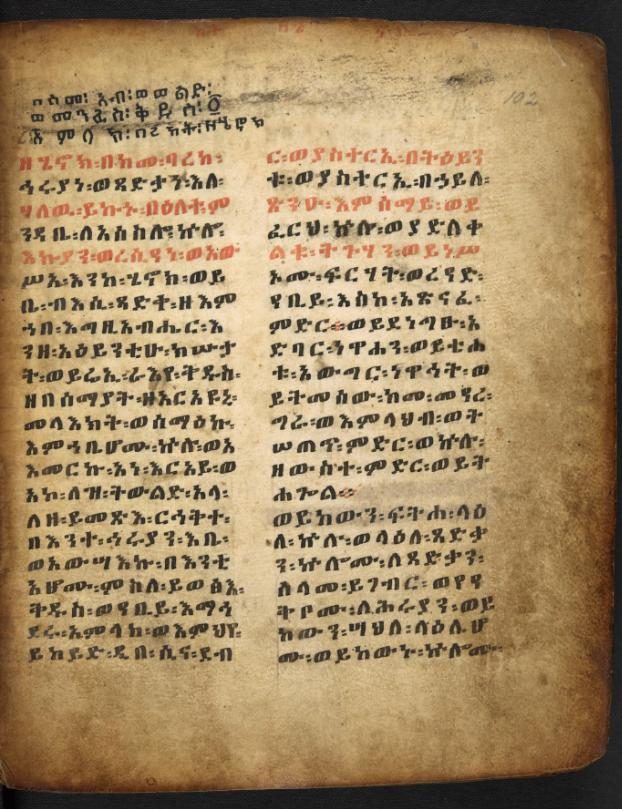
1 ENOCH. 1 Enoch is quoted in the Bible itself, in Jude 14 to 15. Pieces of it were found among the Dead Sea Scrolls, but the only complete copies that survive are in Ge'ez. Ethiopia kept it alive.
WHEN. The number 81 shows up in Ethiopian church writings of the Middle Ages, but which 81 books are counted still differs from list to list today. There is a narrower list and a broader one.
WHAT ABOUT 88 BOOKS? You may see English books online called The Ethiopian Bible, 88 Books. The Ethiopian church does not have an 88 book Bible. Its number is 81, and it reaches 81 in two ways. The narrower list, 54 Old Testament books and 27 New Testament books, is the one printed in the church's own Ge'ez and Amharic Bibles. The broader list counts the Old Testament as 46 books by joining some books together. It then adds church rule books to make a New Testament of 35 books: the Sinodos, the Book of the Covenant, Clement and the Didascalia. Those church books are kept in their own handwritten books. When the scholar Roger Cowley wrote about them in 1974, they had never been printed in the church's Bible.
SO WHERE DOES 88 COME FROM? It comes from publishers, not from Ethiopia. The church has two ways to count to 81. One way has 54 Old Testament books. The other way has 35 New Testament books. If you take the bigger Old Testament and the bigger New Testament and put them together, you get 89. The church never puts them together like that. Some English editions mix the lists in this kind of way, and that is how they land in the high 80s. Some fill in with English translations made from the Greek, not from the Ethiopian Ge'ez. A bigger number may help sell books, but there is no official list of 88.
- ALSO WORTH KNOWING
- The Assyrian Church of the East, one of the oldest churches in the world, still reads a New Testament of only 22 books, without 2 Peter, 2 and 3 John, Jude and Revelation.
- WHAT EVERY CHURCH SHARES
- The Law, the Prophets, the Psalms, the four Gospels, Acts and Paul's letters. The core of the Bible is the same everywhere.
So What Are the Extra Books Good For?
Luther said they are useful and good to read, and he was right. They tell the history of the quiet years, the story of Hanukkah and the faith of the Maccabean martyrs. About the Apocrypha, right after Malachi, walks through every one of them, book by book. Read them like a good history book. Just remember a helpful book is not the word of God.
Canonization Timeline
- ABOUT 450 TO 400 BC
- The Torah is read as Scripture in Ezra's day.
- ABOUT 250 TO 100 BC
- The Septuagint, the Greek Old Testament, is translated in Egypt.
- BY ABOUT 200 BC
- The Prophets are a fixed group.
- ABOUT AD 30
- Jesus speaks of the Law, the Prophets and the Psalms.
- ABOUT AD 95 TO 200
- The Hebrew Bible's list of books is settled in practice.
- AD 367
- Athanasius lists the 27 New Testament books.
- AD 393 TO 419
- Hippo and Carthage list the larger Old Testament.
- AD 692
- The Council in Trullo approves older lists for the Orthodox.
- 1442
- The Council of Florence lists the larger Old Testament.
- 1534
- Luther's Bible sets the Apocrypha apart.
- APRIL 8, 1546
- The Council of Trent fixes the Catholic canon at 73 books.
- 1563 TO 1571
- The Thirty Nine Articles: read them, but not for doctrine.
- 1611
- The King James Bible includes the Apocrypha between the Testaments.
- 1672
- The Synod of Jerusalem lists the Orthodox extra books.
- 1826
- The British and Foreign Bible Society stops funding Bibles with the Apocrypha.
- MIDDLE AGES TO TODAY
- The Ethiopian 81 book canon, still counted in more than one way.
- TODAY
- English editions sold online advertise an 88 book Ethiopian Bible, a publishers' count, not the church's.
The Verdict
Some Bibles have more books because some churches followed the Hebrew Bible of Jesus' day, and others followed the larger Greek Bible the early church read. Ethiopia, far away and on its own, kept even more.
This Bible has the 66 books. Like Luther, we think the extra books are good to read and helpful for knowing the history between the Testaments, but they are not on the same level as Scripture. Whatever Bible you pick up, the story is the same: God made us, we turned away, and He sent His Son to bring us home.
Next questionBut Hasn't the Bible Been Translated Over and Over Again?See the Whole Bible in Color
Free. No spam. Unsubscribe anytime.Something went wrong. Please try again, or email [email protected].