
Frequently Asked Questions · Question 7 of 10
But Hasn't the Bible Been Translated Over and Over Again?
Short answer: not the way you think. Your Bible goes straight back to the Hebrew and Greek.
- THE CLAIM
- The Bible went from Hebrew to Greek to Latin to English, getting changed a little each time, like the telephone game, until nobody knows what it first said.
- THE VERDICT
- Mostly false. Modern Bibles are not the end of a long chain. They are translated straight from Hebrew and Greek copies, and we have more and older copies today than ever.
- THE GRAIN OF TRUTH
- A few early English Bibles really were copies of copies. They were translated from Latin or German instead of the Hebrew and Greek. This page shows you exactly which ones.
- WHY SO MANY TRANSLATIONS
- Two reasons. English keeps changing, and older manuscripts keep turning up.
- WHY THEY SOUND DIFFERENT
- Some translate word for word. Some translate thought for thought. Same original, different style.
- CONFIDENCE
- HIGH.
Get Nate's Highlighting Guide Free
Free. No spam. Unsubscribe anytime.Something went wrong. Please try again, or email [email protected].
The Telephone Game
You probably played it as a kid. One person whispers a sentence to the next, down a line of ten people. Grandma likes pie turns into Grandpa bought a goat. Lots of people think the Bible works the same way. Moses wrote it in Hebrew, somebody turned that into Greek, somebody turned the Greek into Latin, somebody turned the Latin into English, and by now it is so garbled that nobody knows what it first said.
It is a fair question. But that is not how it happened. And for the few English Bibles where it partly did happen, there is a reason we stopped doing it that way.
Branches, Not a Chain
Think of a tree, not a line of people. The Hebrew and Greek manuscripts are the trunk. Every major translation is its own branch growing out of that trunk. Even when a new branch leans on an older one, it still draws from the same trunk.
THE GREEK OLD TESTAMENT. Around 250 BC, Jewish scholars in Egypt began translating the Hebrew Scriptures into Greek, starting with the five books of Moses. The rest took about another hundred years. This is called the Septuagint. It was translated from the Hebrew.
THE LATIN BIBLE. Around AD 382 to 405, a scholar named Jerome made the Latin Bible called the Vulgate. He had studied Hebrew in the desert of Syria, then moved to Bethlehem, where he translated most of the Old Testament straight from the Hebrew, not from the Greek.
YOUR ENGLISH BIBLE. Modern English Bibles are not translated from the Latin. Some start from an older English Bible, but the translators check every verse against the Hebrew and Greek. They work from printed editions of the Hebrew and Greek, built from thousands of handwritten copies, some of them older than Jerome.
Where the Myth Is Partly True
Here is the honest part. A few of the first English Bibles really were copies of copies.
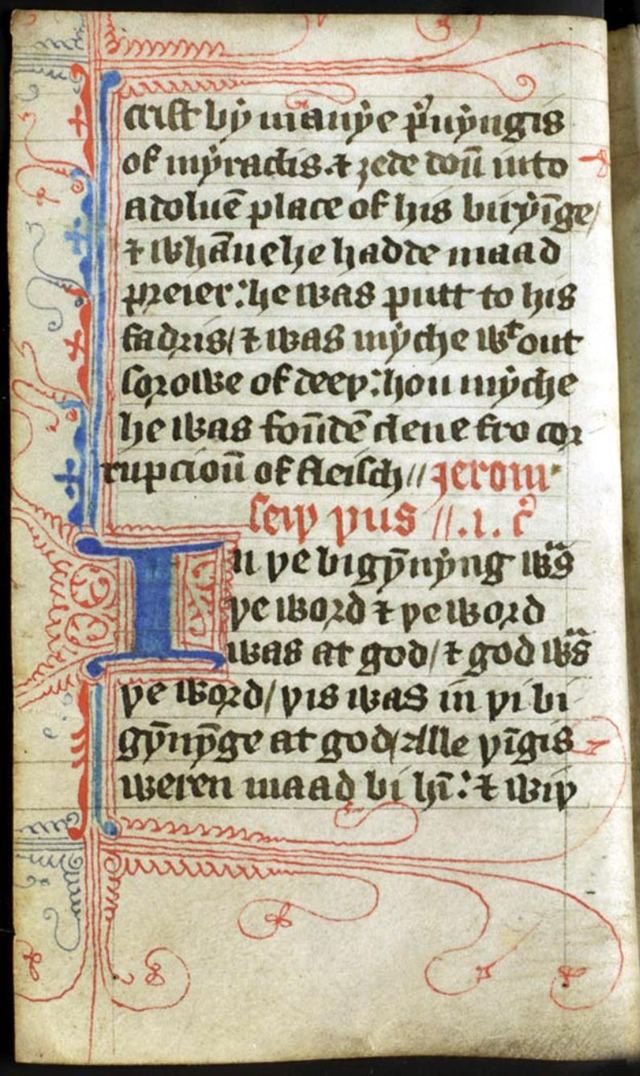
WYCLIFFE, 1380s. The first complete Bible in English came from John Wycliffe and his followers. They translated it from the Latin Vulgate, not from Hebrew and Greek. So it really was a copy of a copy, a translation of a translation. But the printing press had not been invented yet. Every Wycliffe Bible was copied by hand, and church leaders banned unapproved English Bibles in 1409. So there were never very many. About 250 handwritten copies survive today. It was not even printed until hundreds of years later.
TYNDALE, 1526. William Tyndale changed everything. He translated the New Testament straight from Erasmus's printed Greek, and later the first five books of the Old Testament straight from the Hebrew. And he printed it, so it spread by the thousands. He was tried as a heretic, then strangled and burned in 1536.
COVERDALE, 1535. The first complete printed English Bible. Myles Coverdale used Tyndale's work where he could, but Tyndale had only published the first five books of the Old Testament and Jonah. Coverdale was not a Hebrew scholar. So for the rest of the Old Testament, about three quarters of it, he worked mostly from German Bibles, like Luther's, and from Latin ones. That part really was secondhand.
THE MATTHEW BIBLE, 1537. Put together by John Rogers. It used Tyndale's translation from Genesis through 2 Chronicles, including books Tyndale never got to publish. But from Ezra to Malachi, about half the Old Testament, it mostly used Coverdale's secondhand translation.
THE GREAT BIBLE, 1539. The first English Bible approved for every church in England, chained in place in the church so anyone could come read it. Coverdale edited it from the Matthew Bible. For the Old Testament, he checked it against a new Latin translation made straight from the Hebrew by Sebastian Münster. Better, but still partly through Latin.
THE GENEVA BIBLE, 1560. English Protestants who had fled to Geneva, Switzerland, revised the whole Bible against the Hebrew and Greek. It was the Bible of Shakespeare and the Pilgrims. From here on, the Old Testament in Protestant English Bibles was checked against the Hebrew, not just the Latin.
THE BISHOPS' BIBLE, 1568. The Church of England's answer to the Geneva Bible. The bishops revised the Great Bible, checking it against the Hebrew and Greek, so it was no longer secondhand, though some readers found it uneven.
THE KING JAMES BIBLE, 1611. About 50 scholars revised the Bishops' Bible line by line against the Hebrew and Greek, and borrowed heavily from Tyndale and the Geneva Bible.
So yes, for about 30 years in the 1500s, from Coverdale in 1535 to the Bishops' Bible in 1568, parts of the Old Testament in the main Protestant English Bibles came through German and Latin. Catholic English Bibles, starting with the Douay Rheims Bible of 1582 and 1610, kept translating from the Latin until the 1900s. Today, Protestant and Catholic Bibles alike go back to the Hebrew and Greek.
Now Try Reading It
Here is John 3:16 as English Bibles printed it over the years, with the old spellings left in.
- WYCLIFFE, ABOUT 1395
- For God louede so the world, that he yaf his oon bigetun sone, that ech man that bileueth in him perische not, but haue euerlastynge lijf.
- TYNDALE, 1534
- For God so loveth the worlde, yt he hath geven his only sonne, that none that beleve in him shuld perisshe: but shuld have everlastinge lyfe.
- KING JAMES, 1611
- For God so loued þe world, that he gaue his only begotten Sonne: that whosoeuer beleeueth in him, should not perish, but haue euerlasting life.
- THE OWNER'S MANUAL
- For God so loved the world that He gave His one and only Son, that everyone who believes in Him shall not perish but have eternal life.
Notice something. The meaning never changed. God loved the world, gave His Son, and whoever believes gets eternal life. Only the English changed. Old printers used u for v and v for u, þe is an old way to write the, and Wycliffe's yaf is just gave.
Old English Can Trip You Up
Wycliffe's English is over 600 years old, and the King James is over 400 years old. Words drift. Here are a few that would confuse almost anyone today.
- WYCLIFFE, GENESIS 1:1
- In the bigynnyng God made of nouyt heuene and erthe. It means, In the beginning God made heaven and earth out of nothing.
- WYCLIFFE, MATTHEW 6:9
- Oure fadir that art in heuenes, halewid be thi name. It means, Our Father in heaven, holy be Your name.
- KJV, PHILIPPIANS 4:6
- Be careful for nothing. It does not mean be careless. Careful meant full of worry. It means, Do not worry about anything.
- KJV, ACTS 28:13
- We fetched a compass. Paul did not go get a compass. It means, We sailed around.
- KJV, PSALM 4:2
- Seek after leasing. Not renting an apartment. Leasing meant lies.
- KJV, 2 CORINTHIANS 6:12
- Ye are straitened in your own bowels. It means, You are holding back your own affection. People used to say bowels the way we say heart.
- KJV, ISAIAH 3:18
- The round tires like the moon. Not car tires. These were crescent shaped ornaments women wore.
The King James translators would agree with fixing this. In their own preface, they said the Bible should be in the plain language of the people, so even the simplest person could understand it.
So Why Do New Translations Keep Coming Out?
Not because the old ones were wrong, and not because somebody keeps translating translations. There are two big reasons.
1, ENGLISH KEEPS CHANGING. A Bible is only useful if you can understand it. When words like leasing and careful change meaning, a new translation fixes that.
2, WE KEEP FINDING OLDER COPIES. The King James translators worked from printed Greek editions built on only a few late manuscripts. Since then, scholars have found thousands more. Codex Sinaiticus turned up in 1844 and 1859. Papyrus pieces from the 100s and 200s came out of the Egyptian sand starting in the 1890s. The Dead Sea Scrolls, found starting in 1947, gave us Old Testament copies about 1,000 years older than any we had before. Every find gives translators a clearer view of the original.
WE ALSO UNDERSTAND THE WORDS BETTER. Thousands of everyday letters, receipts and contracts from Bible times have been dug up. They show how regular people used Greek words, which helps translators pick the right English word.
Each new translation goes back to the Hebrew and Greek and starts there. The English Revised Version of 1881 and 1885 used the newly found older copies. The Revised Standard Version of 1952 used readings from the Great Isaiah Scroll, found just a few years before. Most newer Bibles, like the NASB, NIV, ESV, CSB and NLT, follow the oldest copies. The NKJV stays with the same Greek as the King James, but shows the differences in its notes.
Word for Word or Thought for Thought?
If they all come from the same Hebrew and Greek, why do they sound different? Because translators have to choose how to carry the words across.
WORD FOR WORD. Stays as close as possible to the exact words and word order of the original, as long as the English still makes sense. Great for study, because you can see what the writer actually said. Sometimes a little stiff. Examples: the KJV, NKJV, NASB and ESV, and The Owner's Manual, which stays close to word for word.
THOUGHT FOR THOUGHT. Asks what a sentence means and says that in natural English. Great for reading big chunks and for new readers. The translator has to make more choices for you. Example: the NLT.
IN THE MIDDLE. Tries to balance exact words and natural English. Examples: the NIV and CSB.
PARAPHRASE. Puts the Bible in the writer's own fresh words. Fun to read next to a real translation, but not a translation itself. Example: The Message.
Here is why thought for thought exists. In Exodus 4:14, the Hebrew literally says the nose of Yahweh burned against Moses. That was how Hebrew said someone was angry. A word for word Bible says the anger of the Lord burned. A thought for thought Bible might say the Lord became angry. All three are correct. Only one of them makes you think God had a nosebleed.
The Only True Word for Word Bible
Here is a secret. Even word for word Bibles move words around. The only Bible that is truly word for word is an interlinear Bible. It prints the Hebrew or Greek on one line, and puts an English word right under each original word, in the original order.
Here is John 3:16 in Greek, one word at a time, in the order John wrote it. The Greek is printed in capital letters, the way the oldest copies were written.
- ΟΥΤΩΣ · houtos
- in this way, so
- ΓΑΡ · gar
- for
- ΗΓΑΠΗΣΕΝ · egapesen
- loved
- Ο · ho
- the
- ΘΕΟΣ · theos
- God
- ΤΟΝ · ton
- the
- ΚΟΣΜΟΝ · kosmon
- world
- ΩΣΤΕ · hoste
- so that
- ΤΟΝ · ton
- the
- ΥΙΟΝ · huion
- Son
- ΤΟΝ · ton
- the
- ΜΟΝΟΓΕΝΗ · monogene
- one and only, only begotten
- ΕΔΩΚΕΝ · edoken
- He gave
- ΙΝΑ · hina
- in order that
- ΠΑΣ · pas
- everyone
- Ο · ho
- the
- ΠΙΣΤΕΥΩΝ · pisteuon
- believing
- ΕΙΣ · eis
- into
- ΑΥΤΟΝ · auton
- Him
- ΜΗ · me
- not
- ΑΠΟΛΗΤΑΙ · apoletai
- should perish
- ΑΛΛ · all
- but
- ΕΧΗ · eche
- should have
- ΖΩΗΝ · zoen
- life
- ΑΙΩΝΙΟΝ · aionion
- eternal
Now read the English straight down, in Greek order: In this way for loved the God the world, so that the Son the one and only He gave, in order that everyone the believing into Him not should perish but should have life eternal.
Every word is there. But nobody talks like that. Greek puts words in a different order than English, and Greek uses the word the in places English does not. So every translator has to move the words into English order. That is not changing the Bible. That is what translating is.
Hebrew does the same thing. Genesis 1:1 in Hebrew, word for word, reads: In beginning created God, et, the heavens and et the earth. The little word et has no English word at all. It just marks what was created. So we move the words around and leave et out: In the beginning God created the heavens and the earth.
Bonus fact: many scholars think that little Greek word houtos at the start of John 3:16 means in this way. So God so loved the world may be about more than how much God loved the world. It is also how He loved it: by giving His Son. And if your King James says his only begotten Son, that is because the Greek text behind it adds the word his.
So Which Bible Should I Read?
The one you will actually read. For study, use a word for word Bible and check it against a second one. For reading big chunks, a thought for thought Bible is great. And if you ever want to see the actual words under the English, look up the verse in a free online interlinear Bible.
When two good translations say a verse a little differently, that is not a contradiction. It is two careful people showing you two sides of the same Greek or Hebrew words. Put them side by side, and you get a fuller picture.
The Verdict
The Bible has not been translated over and over until nobody knows what it said. A few early English Bibles really were secondhand, from Latin or German. But they were handwritten or short lived, and since 1560 Protestant English Bibles have gone back to the Hebrew and Greek, and Catholic ones have too since the 1900s. Today's Bibles are translated from more and older manuscripts than any generation before us ever had.
New translations keep coming because English keeps changing and the ground keeps giving up older copies. The words of God have not changed. The grass withers and the flowers fall, but the word of our God stands forever, Isaiah 40:8.
Next questionWhere Did All the Denominations Come From?See the Whole Bible in Color
Free. No spam. Unsubscribe anytime.Something went wrong. Please try again, or email [email protected].