
Frequently Asked Questions · Question 5 of 10
What About the Gnostic Gospels?
The so called lost books of the Bible, who really wrote them, and why they never made the cut.
- THE CLAIM
- The Gospel of Thomas, the Gospel of Mary, the Gospel of Judas and books like them were real gospels that got taken out of the Bible at the Council of Nicaea.
- THE VERDICT
- False. Nicaea never voted on the books of the Bible, and these books were never in it. You cannot take out a book that was never in.
- WHEN THEY WERE WRITTEN
- Mostly from about AD 140 to 300. That is about 100 to 270 years after Jesus, long after every apostle had died.
- WHO WROTE THEM
- Nobody knows. The writers borrowed famous names like Thomas, Philip, Mary and Judas to make their books sound important.
- WHERE THEY WERE FOUND
- Most in Egypt. The biggest find was a jar of old books dug up near Nag Hammadi in 1945.
- CONFIDENCE
- HIGH that these books came long after the four Gospels.
Get Nate's Highlighting Guide Free
Free. No spam. Unsubscribe anytime.Something went wrong. Please try again, or email [email protected].
The Books They Say Got Banned
You already know the myth from the Nicaea pages. The story says Emperor Constantine and the bishops threw out a pile of gospels they did not like. When people name those banned books, these are almost always the ones they mean.
Here is the twist. These books are real. They are old. Some of them are interesting. But they were never part of the Bible, and nobody at Nicaea voted on them. The church had already been warning people about them for 150 years.
The best way to describe most of them is fan fiction. Fan fiction is when a fan takes famous characters from a story they love and writes brand new adventures for them. The characters are real. The new adventures are not. That is what happened here. Writers in the 100s and 200s took Jesus, Peter, Mary Magdalene and Judas and wrote new stories that put their own ideas in Jesus' mouth.
Who Were the Gnostics?
The word Gnostic comes from the Greek word gnosis, which means knowledge. The Gnostics were groups in the 100s and 200s who mixed bits of Christianity with Greek philosophy and their own myths. There were many kinds, and they did not all agree, but most of them shared a few big ideas.
- THE BODY IS BAD
- Most Gnostics taught that the physical world is evil or broken. Your body is a prison, and your spirit is trying to escape.
- A LESSER GOD
- Many taught that the God of the Old Testament was a lower, clumsy or even evil god who made the world by mistake. Some called him Yaldabaoth.
- SECRET KNOWLEDGE
- You are saved by learning secret knowledge, not by faith in Jesus' death and resurrection. Only a few special people can understand it.
- A JESUS WITH NO REAL BODY
- Many said Jesus only seemed to have a body, or that the real Christ left before the cross. So He did not really die and did not really rise in the flesh.
Now compare that with the Bible. Genesis says God made the world and called it very good, Genesis 1:31. John says the Word became flesh, John 1:14. Paul says if Christ was not raised, our faith is useless, 1 Corinthians 15:17. John even warns that any spirit who will not say Jesus Christ came in the flesh is not from God, 1 John 4:2 to 3.
Paul warned Timothy to turn away from what is falsely called knowledge, 1 Timothy 6:20. The Greek word Paul used there is gnosis. The fight had already started.
The Jar in the Desert
In December 1945, a farmer named Muhammad Ali al Samman was digging for soft soil to use as fertilizer near the town of Nag Hammadi in Egypt. He hit a large clay jar. He was afraid it might hold an evil spirit, but he also hoped it might hold gold, so he smashed it.
Inside were 12 old leather covered books, plus loose pages from a 13th, written in Coptic, the language of Egypt at the time. Today they are called the Nag Hammadi library. Together they hold 52 writings. The story goes that some pages were burned in the family's oven before anyone knew what they were.
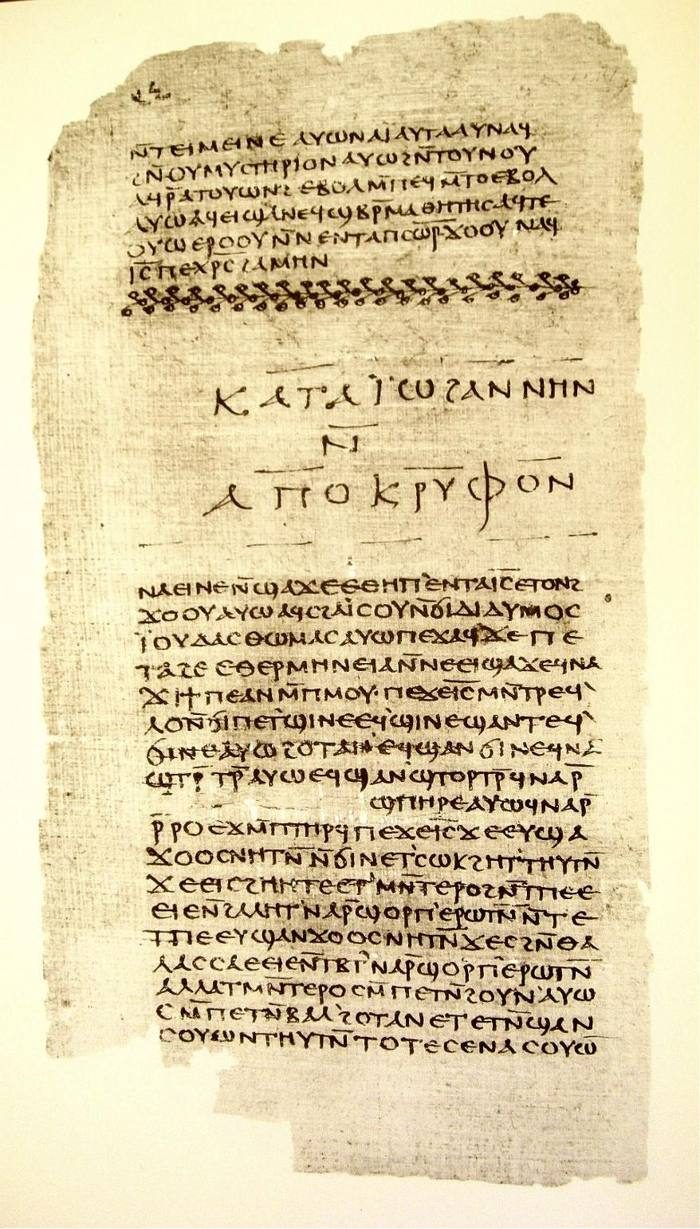
The books themselves were made in the middle 300s. We know because scrap paper used to stiffen the covers includes old letters and receipts with dates in the AD 340s. Someone buried them in the desert, probably in the late 300s. Some scholars think monks from a nearby monastery hid them after church leaders warned against these books, but nobody knows for sure.
Here is a fun fact. One of the writings in the jar is a short piece of Plato's Republic, the famous Greek philosophy book written about 375 BC. That tells you something. This was not a lost Bible. It was a library of spiritual books that a group of people liked to read.
How We Know They Came Later
Scholars do not just guess at the dates. Several clues all point the same way.
CLUE 1, THE EARLY CHURCH SAID SO. About AD 180, a bishop named Irenaeus wrote a five part book called Against Heresies. He names the Gospel of Judas and the Gospel of Truth, and he describes Gnostic myths found in the Nag Hammadi books. He says the Gospel of Truth was written not long ago and agrees in nothing with the Gospels of the apostles. So these books were new in his day, about 150 years after Jesus.
CLUE 2, THEY BORROW FROM OUR GOSPELS. Many of these books quote or copy lines from Matthew, Mark, Luke, John and Paul's letters. A book that copies from another book has to be written after it. Our four Gospels were written in the first century, while people who knew Jesus were still alive.
CLUE 3, THE IDEAS CAME LATER. The big Gnostic myths, with their ranks of heavenly beings and a foolish creator god, match teachers who lived in the 100s, like Valentinus and Basilides. They do not match anything in the first century.
CLUE 4, THE SETTING IS MISSING. Matthew, Mark, Luke and John are packed with real places, real rulers, real Jewish customs and real Jewish names. Most Gnostic gospels have almost none. Jesus talks in an empty space, like a voice in a dream. That is what you expect from someone who never saw first century Israel.
CLUE 5, THE NAMES ARE WRONG. This one is so good it gets its own section.
CLUE 6, THE OLDEST COPIES ARE LATER. The oldest scraps of the four Gospels are often dated to the 100s. The oldest scraps of any Gnostic gospel come from the 200s, and most full copies come from the 300s and later.
The Names Test
Bible scholars Richard Bauckham and Peter J. Williams noticed something amazing. Another scholar, Tal Ilan, made a giant list of every Jewish name we know from Israel between about 330 BC and AD 200, from tombs, letters, coins and books. It has nearly 3,000 people in it. Then they compared it to the names in the Gospels. Bible teacher Wes Huff talked about this on The Joe Rogan Experience in 2025 and helped make it popular.
- MOST COMMON MEN'S NAMES
- Simon was number 1. Joseph was number 2. Then Eleazar, which is Lazarus, Judah, which is Judas, John and Joshua, which is Jesus.
- IN THE GOSPELS
- The same names come out on top. Simon and Joseph are the two most common names in the Gospels and Acts too. For women, Mary and Salome were the two most common names in Israel, and both show up in the Gospels.
Here is why that matters. If you wrote a fake story today about a town in another country 2,000 years ago, you would never get the popular names right. You would not know them. The Gospel writers got them exactly right, because they were writing about real people they knew.
They even have the problem real people have. There are so many Simons and Marys that the Gospels have to add nicknames to tell them apart. Simon Peter, Simon the Zealot and Simon of Cyrene. Mary Magdalene, Mary the mother of James and Mary the wife of Clopas. That is what happens in a town where so many guys are named Simon. Think of a classroom with four kids named Jacob.
Now look at the Gnostic gospels. They use only a handful of famous names, like Peter, Thomas, Mary and Judas, mostly copied from the Bible. Peter Williams points out that they do not show the local pattern the Gospels show. The Gospel of Judas fills the rest of its pages with made up names for heavenly beings, like Barbelo, Saklas, Nebro and Yaldabaoth. No mom in first century Galilee ever named her baby Yaldabaoth. Wes Huff has pointed out that the names in the Gospel of Judas almost never show up in Judea and Galilee in Jesus' day, but they fit Egypt in the 200s and 300s. That is exactly where and when our only copy was made.
The Gnostic Gospels, One by One
Here is every book people usually mean when they say the lost gospels, starting with the true Gnostic books. Dates are what most scholars think, and we tell you when they disagree.
The Gospel of Thomas
The most famous one. It is not a story at all. It is a list of 114 sayings that start with the words, Jesus said. About half sound a lot like sayings in Matthew, Mark and Luke. The rest sound strange. The last saying has Peter tell Mary to leave because women are not worthy of life, and Jesus answers that He will make her male so she can enter the kingdom. There is no birth, no miracles, no cross and no resurrection.
- WRITTEN
- Most scholars say the middle 100s. A smaller group, including the famous Jesus Seminar in 1993, argued for the first century and called it a fifth gospel. Others answer that it borrows from the four Gospels and even uses wording from later Syriac Christianity.
- OLDEST COPIES
- Three Greek scraps found at Oxyrhynchus, Egypt, from about AD 200 to 250. The full copy is in Coptic, from the Nag Hammadi jar, made in the 300s.
- WHY IT IS NOT SCRIPTURE
- The wider church never read it as Scripture, and early writers warned against it. Only fringe groups used it. Its Jesus saves by secret sayings, not by His death and resurrection. Some scholars call it only partly Gnostic, but it still fits the secret knowledge pattern.
- CONFIDENCE
- HIGH that it is not from the apostle Thomas. MEDIUM on the exact date.
The Gospel of Philip
A rambling collection of thoughts about secret rituals, especially one called the bridal chamber. It is famous for one line that says Jesus loved Mary Magdalene more than the other disciples and used to kiss her on the. Then there is a hole in the page. The Da Vinci Code filled in the hole with the word mouth. Nobody knows what the missing word was. Other Gnostic books have Jesus kiss male disciples too, and kissing was a normal greeting among believers, Romans 16:16.
- WRITTEN
- Probably the 200s.
- OLDEST COPY
- One Coptic copy from the Nag Hammadi jar, 300s.
- WHY IT IS NOT SCRIPTURE
- It is full of Valentinian Gnostic teaching from the 100s and 200s. It was never read in any church. The Da Vinci Code also said its word for companion proves Jesus was married. The word is a Greek loan word that usually means partner or companion. It does not have to mean wife, and the book never says Jesus was married.
- CONFIDENCE
- HIGH.
The Gospel of Truth
Not really a gospel. It is a poetic sermon about how people forgot the Father and were saved when Jesus brought them knowledge. It is lovely in places, but it tells almost nothing about Jesus' life.
- WRITTEN
- About AD 140 to 180. Some scholars think the Gnostic teacher Valentinus wrote it himself.
- OLDEST COPIES
- Two Coptic copies from the Nag Hammadi jar, 300s.
- WHY IT IS NOT SCRIPTURE
- Irenaeus, about AD 180, says the followers of Valentinus wrote a Gospel of Truth not long ago, and that it agrees in nothing with the real Gospels. Most scholars think this is the same book.
- CONFIDENCE
- HIGH.
The Gospel of the Egyptians
Also called the Holy Book of the Great Invisible Spirit. It is a long, strange myth about heavenly beings with names like Barbelo and the great Seth, who comes down to save his chosen family. Jesus barely appears. It is not the same book as an older Greek Gospel of the Egyptians that the church writer Clement of Alexandria quoted, which is lost.
- WRITTEN
- Probably the 200s.
- OLDEST COPIES
- Two Coptic copies from the Nag Hammadi jar, 300s.
- WHY IT IS NOT SCRIPTURE
- It teaches a whole Gnostic universe that is found nowhere in the Old or New Testament. Its hero is Seth, not Jesus.
- CONFIDENCE
- HIGH.
The Gospel of Mary
After the resurrection, a woman named Mary, usually thought to be Mary Magdalene, tells the disciples about a secret vision Jesus gave her about how the soul climbs past evil powers to rest. Andrew says these sound like strange ideas. Peter asks if Jesus really talked to a woman in private and not to them. Levi defends her. About half the pages are missing, including the first six.
- WRITTEN
- The 100s, probably the second half.
- OLDEST COPIES
- Two Greek scraps from the 200s. The longest copy is in Coptic, in the Berlin Codex, a book bought in Cairo in 1896 and made in the 400s or 500s. It was not in the Nag Hammadi jar.
- WHY IT IS NOT SCRIPTURE
- Its message is the Gnostic climb of the soul past heavenly gatekeepers, not the gospel of the cross. No early list of Scripture ever names it. It is worth knowing that the real Gospels already honor Mary Magdalene as the first person to see the risen Jesus, John 20:11 to 18. She did not need a fake gospel.
- CONFIDENCE
- HIGH.
The Gospel of Judas
The book that made headlines when National Geographic published it in 2006. In it, Judas is the hero. Jesus laughs at the other disciples and tells Judas he will do something greater than all of them. He will sacrifice the man that clothes Jesus, meaning he will help Jesus escape His body. A big part of the book is a long myth about heavenly beings like Barbelo, Saklas and Nebro. It ends with Judas handing Jesus over and getting paid.
- WRITTEN
- Before about AD 180, because Irenaeus names a Gospel of Judas used by a Gnostic group. Most scholars say the middle 100s.
- OLDEST COPY
- One Coptic copy in a book called Codex Tchacos, found in Egypt in the 1970s. Carbon dating puts it at about AD 220 to 340. It sat in a bank box in New York for years and was badly damaged before scholars got it.
- WHY IT IS NOT SCRIPTURE
- Irenaeus already called it a made up story in AD 180. Its Jesus hates the body and mocks the God of the Bible. Some scholars who studied it later even argue Judas is not really a hero in it, just a tool of evil powers.
- CONFIDENCE
- HIGH.
The Secret Book of John
Also called the Apocryphon of John. The risen Jesus appears to John and explains the secret story of creation. A high spiritual being named Sophia, which means wisdom, makes a mistake and gives birth to Yaldabaoth, an ugly lion faced god who thinks he is the only God. That is the god who made our world. In this story, Jesus says it was He who got Adam and Eve to eat from the tree of knowledge, to help them escape the lesser god.
- WRITTEN
- The 100s. Irenaeus, about AD 180, describes a myth very close to it.
- OLDEST COPIES
- Four Coptic copies, three from Nag Hammadi and one in the Berlin Codex. So it was clearly popular with Gnostics.
- WHY IT IS NOT SCRIPTURE
- It turns the God of Genesis into a villain. That is the opposite of what Jesus taught, who called the God of Abraham, Isaac and Jacob His Father, Matthew 22:32, John 8:54.
- CONFIDENCE
- HIGH.
The Rest of the Gnostic Shelf
These get mentioned less, but people sometimes list them as lost gospels too.
- SECRET BOOK OF JAMES
- A letter where Jesus gives Peter and James secret teaching 550 days after the resurrection. Written in the 100s or 200s. Nag Hammadi.
- DIALOGUE OF THE SAVIOR
- Jesus answers questions from Judas, Matthew and Mary about the soul and the end. Written in the 100s or 200s. Nag Hammadi.
- BOOK OF THOMAS THE CONTENDER
- Jesus tells Thomas to escape the fire of bodily desire. Written in the 200s. Nag Hammadi.
- WISDOM OF JESUS CHRIST
- Also called the Sophia of Jesus Christ. A Gnostic letter called Eugnostos, rewritten so that Jesus says the words. Written in the 100s or 200s. Nag Hammadi and the Berlin Codex.
- THE COPTIC APOCALYPSE OF PETER
- Peter sees a vision of the cross, and the real Jesus stands nearby laughing while only His body is nailed up. Written in the 200s. Nag Hammadi. Not the same as an older Greek Apocalypse of Peter that some early churches read.
- PISTIS SOPHIA
- Jesus stays on earth 11 years after the resurrection and teaches long secret lessons. Written in the 200s. Found in the Askew Codex, which the British Museum bought in 1785.
- THE BOOKS OF JEU
- Secret passwords and seals for getting past the rulers of the heavens. Written in the 200s. Found in the Bruce Codex, bought in Egypt in 1769.
- WHY NONE ARE SCRIPTURE
- All of them are late, all of them teach the Gnostic myth, and none of them were ever read in the churches as the word of God.
Not Gnostic, But Often Lumped In
Some books get thrown in with the Gnostic gospels even though they are not Gnostic. They are more like Bible fan fiction from regular Christians, written to fill in the parts the Gospels skip, like Jesus' childhood.
The Infancy Gospel of Thomas
Stories about Jesus as a boy from age 5 to 12. He makes sparrows out of clay and they fly away. When a boy bumps into Him, Jesus curses him and the boy drops dead. When a teacher hits Him during an alphabet lesson, Jesus curses him and the teacher falls to the ground. Later He heals people and the stories get nicer. It is a little like a superhero origin story, written by someone who forgot that Jesus never sinned.
- WRITTEN
- The late 100s. Irenaeus mentions the alphabet story.
- WHY IT IS NOT SCRIPTURE
- John says turning water into wine was the first of Jesus' signs, John 2:11. So the Bible points to no childhood miracles. This Jesus is mean in a way the real Jesus never was. The clay birds story is also told in the Quran, Surah 3:49 and 5:110.
- CONFIDENCE
- HIGH.
The Gospel of Peter
Only part of it survives. It tells the trial, death and resurrection of Jesus. It blames Herod instead of Pilate. On the cross, Jesus is silent as if He felt no pain. At the tomb, two angels come out with heads that reach up to the sky, holding up a third whose head goes past the sky, and a cross floats out behind them and talks.
- WRITTEN
- About AD 150.
- LONGEST COPY
- A copy from the 700s to 900s, found in a monk's grave at Akhmim, Egypt, in 1886 to 1887. Two tiny older scraps from Oxyrhynchus may also be from this book.
- WHY IT IS NOT SCRIPTURE
- Around AD 200, Bishop Serapion of Antioch at first let a church read it. Then he read it himself, found false teaching about Jesus' body in it, and banned it. The historian Eusebius tells the story. Also, a talking cross.
- CONFIDENCE
- HIGH.
The Gospel of Nicodemus
Also called the Acts of Pilate. It retells Jesus' trial with extra witnesses, then tells how Jesus went down to the dead and set Adam and the Old Testament saints free. That part is called the harrowing of hell, and it became very popular in the Middle Ages.
- WRITTEN
- In its present form, the 300s or 400s. Justin Martyr, about AD 150, mentions Acts of Pilate, but he probably meant official Roman records, not this book.
- WHY IT IS NOT SCRIPTURE
- It is centuries too late and was written to build on the Gospels, not to report what eyewitnesses saw.
- CONFIDENCE
- HIGH.
The Jewish Christian Gospels
Early church writers mention a Gospel of the Hebrews, a Gospel of the Nazarenes and a Gospel of the Ebionites. We do not have any of them. We only have short quotes in books by Origen, Jerome and Epiphanius. The Ebionite one turned John the Baptist into a vegetarian. It changed his locusts into honey cakes.
- WRITTEN
- The 100s.
- WHY THEY ARE NOT SCRIPTURE
- They seem to be reworked versions of Matthew, used by small groups who mixed faith in Jesus with strict Jewish law, and some of them denied that Jesus was born of a virgin. The wider church never read them as Scripture.
- CONFIDENCE
- MEDIUM, because so little survives.
The Gospel of Barnabas
This one is often shared online by Muslims, because in it Jesus says He is not the Messiah, and He says Muhammad is coming. It also says Judas was made to look like Jesus and was crucified in His place.
- WRITTEN
- The 1300s to 1500s, more than 1,300 years after Jesus. The two old copies are in Italian and Spanish.
- HOW WE KNOW
- It mentions a Jubilee every 100 years. That was a rule made by Pope Boniface VIII in the year 1300 and changed in 1343. A first century writer could not know about it. It also contradicts the Quran itself, which calls Jesus the Messiah.
- CONFIDENCE
- HIGH that it is a medieval book.
What Do These Books Have to Do With the Quran?
Islam began around AD 610, when Muhammad said the angel Gabriel was bringing him messages from God in Arabia. Muslims believe the Quran is God's own word. It honors Jesus, calls Him the Messiah, and says it confirms the Torah and the Gospel that came before it, Surah 3:3 and 5:46.
Here is what surprises a lot of people. Several of the Quran's stories about Jesus and Mary are not in the Bible at all. But stories very much like them show up in the books on this page and in other Christian legends written long after the apostles.
- CLAY BIRDS
- The Quran says Jesus made birds out of clay, breathed on them, and they flew, Surah 3:49 and 5:110. That story is not in the Bible, but a very close version is in the Infancy Gospel of Thomas, from the late 100s.
- THE TALKING BABY
- The Quran says newborn Jesus spoke from the cradle to defend His mother, Surah 19:29 to 33. In the Arabic Infancy Gospel, baby Jesus also speaks from the cradle, but there He tells Mary that He is the Son of God. Its oldest copies are from long after the Quran, and scholars argue about how old the story really is, so this one is less certain.
- THE PALM TREE
- The Quran says Mary gave birth under a palm tree, which dropped fresh dates, and a stream flowed beneath her, Surah 19:23 to 26. In the Gospel of Pseudo Matthew, a palm tree bends down to give Mary dates and a spring bursts out of its roots, during the trip to Egypt. That book was written around the same time as the Quran or later, so neither one copied the other. Scholars think both came from an older Christian story told near Bethlehem.
- SOMEONE ELSE ON THE CROSS
- The Quran says Jesus was not killed or crucified, but it was made to look that way, Surah 4:157. That idea sounds a lot like what some Gnostic teachers said centuries earlier. About AD 180, Irenaeus wrote that the Gnostic teacher Basilides taught that Simon of Cyrene died in Jesus' place. A Nag Hammadi book called the Second Treatise of the Great Seth has Jesus laughing while another man suffers.
So how did these stories get to Arabia? In Muhammad's day there was no Arabic Bible that we know of. The oldest Arabic copies of the Gospels we have come from after Islam began. Most people could not read, and books were rare and very expensive. So Christian stories traveled by word of mouth, from Syriac speaking Christians, monks, traders and Christian tribes in Arabia. A Bible story and a popular legend sounded the same when someone told them around a fire. A listener had no way to look it up.
The Quran also retells some Jewish teachings that are not in the Old Testament. Surah 5:32 says that killing one person is like killing all people, and saving one is like saving all people. That saying is in the Mishnah, a Jewish book from about AD 200. Even the story of a raven showing Cain how to bury Abel, Surah 5:31, has a cousin in Jewish legends where a raven teaches Adam.
Muslims answer that God told Muhammad what really happened, and that some true events were also remembered in other books. Many historians see it another way. They say the Quran repeats stories that were going around at the time, including legends written hundreds of years after Jesus. Either way, one fact is clear. The Bible itself does not contain these stories. If a book says it confirms the Gospel, but some of its stories about Jesus match legends written centuries later instead, that is worth thinking about.
Two Modern Fakes
THE SECRET GOSPEL OF MARK. In 1958, a scholar named Morton Smith said he found a copy of an old letter at the Mar Saba monastery near Jerusalem. The letter quotes a secret, longer Gospel of Mark. Only photos exist now. The original page went missing. Many scholars think Smith faked it himself, while others still defend it. Confidence that it is real: LOW.
THE GOSPEL OF JESUS' WIFE. In 2012, a Harvard professor announced a tiny scrap of papyrus where Jesus says, my wife. It made the news all over the world. In 2016, a reporter tracked down the man who sold it and showed it was a modern forgery, and the professor agreed it was probably fake. Confidence that it is real: none.
So Who Really Took Books Out of the Bible?
Funny story. The first person we know of who cut books out of the Bible was not a bishop at Nicaea. It was a rich ship owner named Marcion, around AD 140. He decided the God of the Old Testament was a different, harsher god than the Father of Jesus. So he threw out the whole Old Testament, kept only an edited version of Luke and ten of Paul's letters, and cut out any verse he did not like.
The church in Rome rejected him in AD 144. One reason the church started making clear lists of the true books was to answer people like Marcion and the Gnostics. The church did not take books out of the Bible. It defended the Bible from people who were trying to.
Are They Worth Reading?
For historians, yes. These books show us what some groups believed in the 100s, 200s and 300s. A few of the sayings in the Gospel of Thomas might even go back to things Jesus really said, because they are so close to the four Gospels.
But reading them is a little like reading fan fiction after reading the real book. You quickly see the difference. The real Gospels sound like eyewitness reports from a real place. The Gnostic gospels sound like a dream. Peter said it best. We did not follow cleverly made up stories, he wrote. We were eyewitnesses of His majesty, 2 Peter 1:16.
The Lost Gospels at a Glance
- BOOK
- WRITTEN · WHERE THE OLDEST COPY CAME FROM
- Matthew, Mark, Luke, John
- First century, about AD 50 to 95 · Scraps from the 100s and 200s, from Egypt
- Gospel of Thomas
- Middle 100s, debated · Greek scraps about AD 200, Coptic copy 300s
- Gospel of Truth
- About AD 140 to 180 · Nag Hammadi, 300s
- Gospel of Judas
- Middle 100s · Codex Tchacos, about AD 220 to 340
- Secret Book of John
- The 100s · Nag Hammadi and Berlin Codex, 300s to 500s
- Gospel of Mary
- Late 100s · Greek scraps 200s, Berlin Codex 400s or 500s
- Gospel of Philip
- The 200s · Nag Hammadi, 300s
- Gospel of the Egyptians
- The 200s · Nag Hammadi, 300s
- Infancy Gospel of Thomas
- Late 100s · A papyrus scrap from the 300s or 400s
- Gospel of Peter
- About AD 150 · Akhmim, 700s to 900s, maybe older scraps
- Gospel of Nicodemus
- 300s or 400s · Later copies
- Gospel of Barnabas
- 1300s to 1500s · Italian and Spanish copies
- Secret Mark
- Claimed old, likely modern · Photos from 1958 only
- Gospel of Jesus' Wife
- Modern forgery · Shown fake in 2016
The Verdict
The so called lost gospels were not lost, and they were not stolen out of the Bible at Nicaea. They were written by unknown people, more than 100 years after Jesus, who borrowed famous names to sell new ideas. The early church knew about them, read them, and said no, long before Constantine was even born.
The four Gospels have the real places, the real customs and even the real popular names of first century Israel. The Gnostic gospels have a secret Jesus with no real body, a villain God and names like Yaldabaoth. One sounds like history. The other sounds like fan fiction. You can check them for yourself, just like the Bereans did, Acts 17:11.
Next questionWhy Do Some Bibles Have More Books?See the Whole Bible in Color
Free. No spam. Unsubscribe anytime.Something went wrong. Please try again, or email [email protected].