
Frequently Asked Questions · Question 9 of 10
Who Was the Real Santa Claus?
A rich young bishop who gave his money away, and the legends that grew around him.
- HIS NAME
- Nicholas of Myra. Nicholas means victory of the people in Greek.
- BORN
- About AD 270 in Patara, a port town in Lycia, on the southern coast of what is now Turkey.
- JOB
- Bishop of Myra, a town near Patara. Today it is called Demre.
- DIED
- December 6, around AD 343, by tradition. That is why his feast day is December 6.
- BURIED
- First at Myra. Since 1087 most of his bones have been in Bari, Italy.
- KNOWN FOR
- Giving gifts in secret, protecting children, sailors and the poor, and, according to legend, slapping a heretic.
- CONFIDENCE
- HIGH that he was a real bishop of Myra in the 300s. LOW to MEDIUM for most of the stories told about him.
Get Nate's Highlighting Guide Free
Free. No spam. Unsubscribe anytime.Something went wrong. Please try again, or email [email protected].
The Real Man
We know less about the real Nicholas than you might think. No letters or sermons of his survive, and the first stories about him were written down a long time after he died. But here is what the old traditions agree on.
Nicholas was born to a rich Christian family. His parents died while he was young, and he was left with a lot of money. Instead of keeping it, he gave it away to people in need, often in secret. He became the bishop of Myra while he was still young.
Those were hard years to be a Christian. Under Emperor Diocletian, starting in AD 303, churches were torn down and Christian leaders were arrested. Tradition says Nicholas was thrown in prison for his faith and set free when Constantine came to power.
Tradition also says he was at the Council of Nicaea in AD 325, where he is said to have slapped Arius. That story was first written down about 1,000 years later. See Didn't They Take Books Out of the Bible at the Council of Nicaea?, Didn't They Take Books Out of the Bible at the Council of Nicaea?.
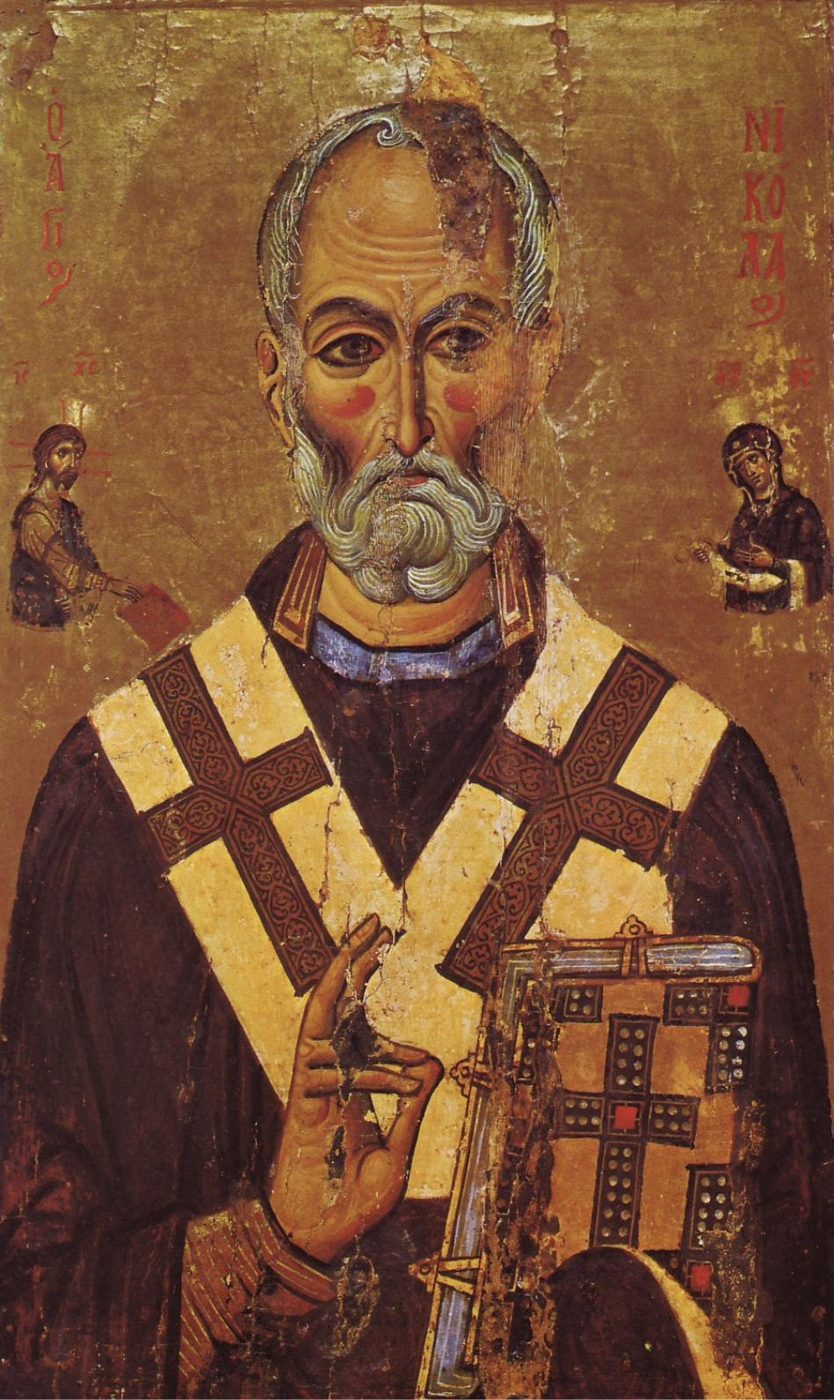
The Bags of Gold
This is the most famous story about him, and it is the root of Santa Claus. A man in Nicholas's town had lost all his money. He had three daughters. In those days a young woman needed a dowry, money her family gave when she married. With no dowry, nobody would marry them, and the father was about to sell them into prostitution to survive.
Nicholas heard about it. One night he walked to the man's house and tossed a bag of gold through the open window. Now the oldest daughter could marry. Later he did it again for the second daughter.
The third time, the father hid and waited to see who was doing it. He caught Nicholas and fell at his feet to thank him. Nicholas made him promise to keep it a secret, because he wanted the glory to go to God.
- WHERE IT LEADS
- Later tellers said the gold fell down the chimney, or landed in stockings hung by the fire to dry. Many people say that is where Christmas stockings and chocolate gold coins come from.
- THE THREE GOLD BALLS
- Paintings often show Nicholas holding three gold balls for the three bags. Pawn shops later used three gold balls as their sign.
- THE BIBLE BEHIND IT
- When you give to the needy, do not let your left hand know what your right hand is doing, so that your giving may be in secret, Matthew 6:3 to 4.
- CONFIDENCE
- MEDIUM. The story is told in the oldest Life of Nicholas, written in the 800s, about 500 years after him.
Did He Raise the Dead?
The legends say yes, more than once. Here are the big ones.
THE THREE BOYS IN THE BARREL. A wicked innkeeper killed three boys who were traveling to school, cut them up and salted them in a barrel. In later versions he is a butcher during a famine who planned to sell them as meat. Nicholas walked in, saw what had happened, prayed, and the three boys climbed out of the barrel alive. This is the main reason he became the patron saint of children. The story first shows up in Western Europe around the year 1100, more than 700 years after Nicholas.
THE SAILOR WHO FELL. Sailors caught in a storm prayed to Nicholas, and he appeared on the deck and calmed the sea. In some versions a sailor fell from the mast and died, and Nicholas brought him back to life. That is why sailors call him their patron saint.
THE THREE INNOCENT MEN. One of the oldest stories, written within about 100 to 200 years after his death, says three innocent men were about to be beheaded. Nicholas ran up, grabbed the executioner's sword, and set them free. Nobody died in that one, but it shows what people remembered about him: he stood up for the helpless.
- THE HONEST ANSWER
- The Bible tells of real people raised from the dead, like the widow's son, Luke 7:11 to 17, and Lazarus, John 11. God can do it any time He wants. But the stories about Nicholas raising the dead were written down hundreds of years after he lived, and nobody who was there wrote them.
- CONFIDENCE
- LOW for the miracle stories. They are best read as legends that tell what kind of man people believed he was.
More Stories People Told
THE BABY WHO STOOD UP. One legend says baby Nicholas stood up by himself in his first bath, and that he would only nurse once on Wednesdays and Fridays, the old fast days.
THE GRAIN SHIPS. During a famine in Myra, Nicholas asked sailors carrying grain for the emperor to give some to his city. When they reached the capital, their ships still held the full amount.
THE BOY CAPTURED BY RAIDERS. A boy named Basil was carried off and made a servant in a faraway palace. A year later, on Nicholas's feast day, the boy was suddenly back home holding the cup he had been serving from.
How He Became a Saint
In the early church nobody filled out paperwork to become a saint. Saint means holy one, and the New Testament calls all believers saints, Romans 1:7. Over time the churches began honoring people known for holy lives, especially martyrs and great leaders, and remembering them on the day they died.
Nicholas was honored by the people long before there were any official rules. By the 500s Constantinople had a church named for him and another saint, and Emperor Justinian rebuilt it. He became one of the most loved saints in both the Eastern and Western churches, with thousands of churches named for him.
In 1087 sailors from Bari, Italy, sailed to Myra, opened his tomb and carried most of his bones home. Bari still keeps them in the Basilica of San Nicola. Venice later took many of the small pieces that were left. In 2017 scientists at Oxford tested a piece of pelvis said to be his, and it dated to the 300s, the right time for Nicholas. That does not prove it is his, but it is not a fake from later times.
How Saint Nicholas Turned Into Santa Claus
DECEMBER 6. For hundreds of years, children in Europe got small gifts on Saint Nicholas Day, or the night before. In the Netherlands he was called Sinterklaas.
MARTIN LUTHER. During the Reformation, Luther taught people not to pray to saints. He spoke of the Holy Christ bringing gifts at Christmas, to point children to Jesus instead of a saint. Over the next years many Protestant families moved the gifts from December 6 to Christmas, and the Christ Child, the Christkind, became the gift bringer in much of Germany.
NEW YORK. The name Santa Claus most likely came from the Dutch Sinterklaas. In 1809 the writer Washington Irving made a jolly Saint Nicholas part of old New York stories. In 1821 a poem showed him on a sleigh pulled by a reindeer, bringing gifts on Christmas Eve.
THE NIGHT BEFORE CHRISTMAS. In 1823 the poem A Visit from St. Nicholas, which begins 'Twas the night before Christmas, made famous the chimney, the sleigh, eight reindeer with names, and a jolly old elf with a little round belly that shook when he laughed. It is usually credited to Clement Clarke Moore, though some argue Henry Livingston Jr. wrote it.
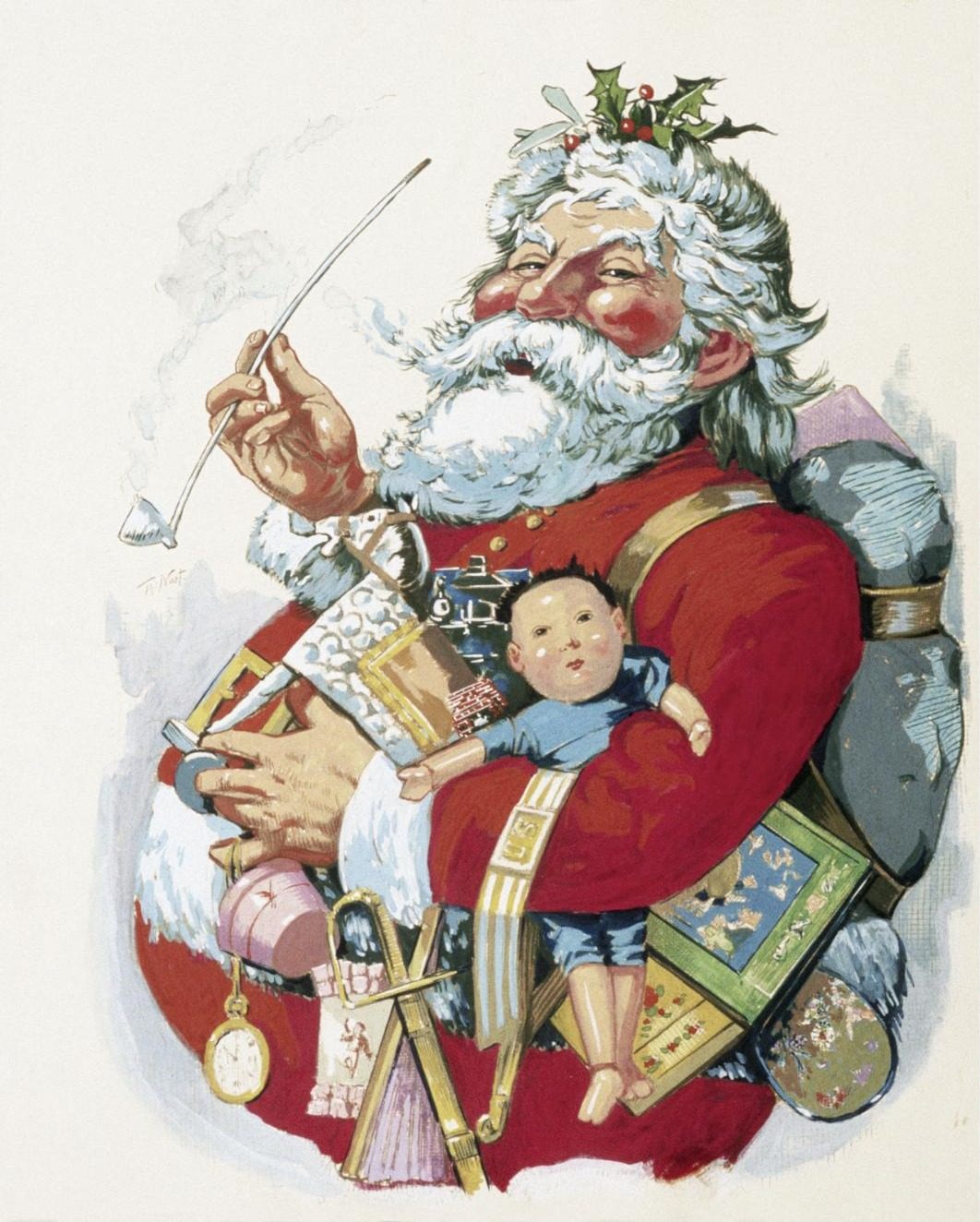
THE PICTURE. Cartoonist Thomas Nast drew Santa for Harper's Weekly from the 1860s to the 1880s and gave him a home at the North Pole and a workshop. In the 1930s Coca Cola ads by Haddon Sundblom made the big, red suited Santa famous all over the world. Coke did not invent the red suit, but it made it the one everybody pictures.
Where Did Christmas Come From?
The Bible never gives the date Jesus was born. The first Christians did not celebrate His birthday at all. They celebrated His resurrection every Sunday and at Easter.
THE FIRST RECORD. The oldest record of a December 25 Christmas comes from Rome. A calendar made in AD 354 lists December 25 as the day Christ was born in Bethlehem, and it shows the church in Rome keeping it by about AD 336.
WHY DECEMBER 25? There are two main answers. One says early Christians believed Jesus was conceived on the same day of the year that He died, March 25, so they counted nine months later and got December 25. The other says the church chose a day already full of Roman celebrations, like the feast of the Unconquered Sun on December 25 and the Saturnalia a week earlier, to give people a Christian reason to celebrate. Scholars still argue about which came first. See Was Jesus Born on December 25?, Luke, p.···.
JANUARY 6. Many churches in the East first celebrated Jesus' birth on January 6. Armenian churches still do. Orthodox churches that use the old Julian calendar keep December 25 on what is January 7 on our calendar.
CHRISTMAS GETS BANNED. The Puritans thought Christmas had turned into a pagan party. In 1647 Parliament in England banned it, and from 1659 to 1681 Massachusetts fined anyone caught celebrating it five shillings.
CHRISTMAS COMES BACK. In the 1800s Christmas grew into a family holiday, helped along by Charles Dickens's A Christmas Carol in 1843. In 1870 the United States made Christmas a federal holiday.
The Verdict
Santa Claus is make believe, but Saint Nicholas was real. He was a bishop who loved Jesus, stood up for the truth about who Jesus is, and gave away his money in secret to rescue girls who had no one else to help them. Most of the miracle stories are legends, and the flying reindeer are pure American invention.
The best part of the real story is the part that matters most. Nicholas gave because God gave first. For God so loved the world that He gave His one and only Son, John 3:16. That is the gift Christmas is about.
Next questionIs Heaven or Hell Real?See the Whole Bible in Color
Free. No spam. Unsubscribe anytime.Something went wrong. Please try again, or email [email protected].